Explore the A1Z26 Number-Letter Mapping
Choose Letters to Numbers for the A-to-Z mapping, or Numbers to Letters for independent 1-to-26 tokens. Both directions use the same documented local rule.
Text
0 / 500
A1Z26 Numbers
The local A1Z26 result will appear here...
A1Z26 Input and Output Examples
These pairs cover both directions and show how the local rule handles punctuation, values outside 1 through 26, decimals, and tokens attached to letters.
English
ABC
Translation
1 2 3
ABC encoded as A1Z26 values
English
Hello!
Translation
8 5 12 12 15!
Hello encoded with punctuation preserved
English
1 2 26
Translation
A B Z
Independent A1Z26 values decoded
English
1,2; (26)
Translation
A,B; (Z)
A1Z26 values decoded around punctuation
English
0 27 -1
Translation
0 27 -1
Out-of-range and signed values preserved
English
1.5 A1 1A
Translation
1.5 A1 1A
Decimal and letter-attached values preserved
Number-Letter Reference Tables
| Number | Letter | Number | Letter | Number | Letter |
|---|---|---|---|---|---|
| 1 | A | 10 | J | 19 | S |
| 2 | B | 11 | K | 20 | T |
| 3 | C | 12 | L | 21 | U |
| 4 | D | 13 | M | 22 | V |
| 5 | E | 14 | N | 23 | W |
| 6 | F | 15 | O | 24 | X |
| 7 | G | 16 | P | 25 | Y |
| 8 | H | 17 | Q | 26 | Z |
| 9 | I | 18 | R |
A1Z26 Alphabet Positions
This fixed table is the rule used by the local converter. Forward conversion reads from letter to number, and reverse conversion reads from an independent 1-to-26 value to its uppercase letter.
Reverse Token Examples
Reverse conversion changes only an independent integer from 1 through 26. These examples show which nearby characters form a valid boundary and which keep the input unchanged.
| Input | Result | Reason |
|---|---|---|
| 1 | A | Independent value |
| 26 | Z | Independent value |
| 0 | 0 | Outside 1 through 26 |
| 27 | 27 | Outside 1 through 26 |
| -1 | -1 | Signed value |
| 1.5 | 1.5 | Decimal value |
| A1 | A1 | Attached to a letter |
| 1-2 | 1-2 | Hyphen-joined values |
Useful Ways to Read the Mapping
Puzzles with an Explicit Key
A1Z26 can support a classroom or puzzle exercise when every participant knows that A=1 through Z=26. Include separators and the key so a reader can identify the intended convention.
Mixed Text Remains Readable
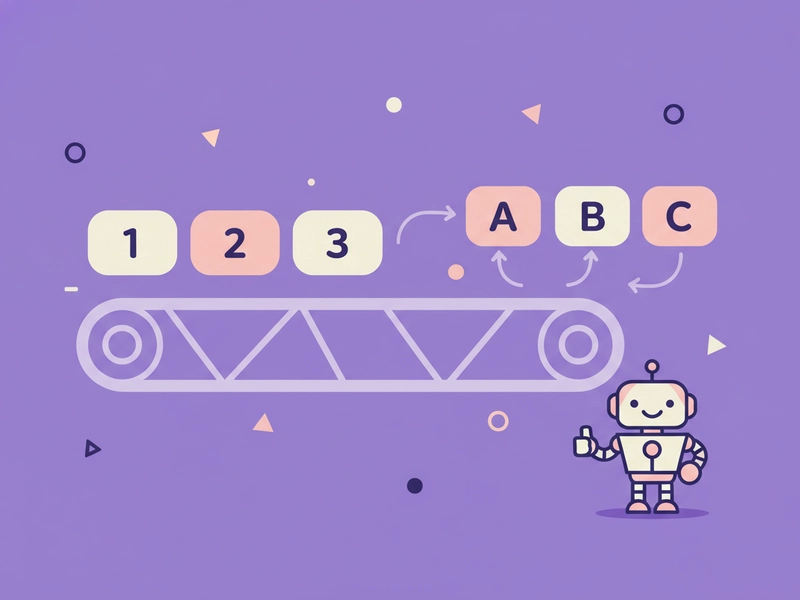
Punctuation, line breaks, spaces, accented characters, and other scripts remain in their original positions. Only ASCII A-Z letters change in the forward direction.
A Visible Puzzle Convention
A1Z26 is a reversible alphabet substitution that is easy to recognize. Treat it as a display or puzzle convention rather than a method for protecting sensitive material.
Learning Alphabet Positions
The fixed reference table is useful for checking alphabet positions by hand. Because the converter follows that table directly, each valid input can be traced to one documented rule.

Current Numbers-to-Letters Tool Boundaries
These details describe the deployed interaction rather than features the page does not have.
Two Defined Directions
Letters to Numbers maps ASCII A-Z to 1 through 26. Numbers to Letters maps only independent 1-to-26 tokens to uppercase A-Z.
Deterministic Local Mapping
The same A1Z26 transform handles this slug through convertLocalToolText and returns before the shared API fallback.
No Metered Translation Call
This local conversion does not require sign-in, a daily allowance, or a translation credit, and it does not send the input to /api/gemini.
Boundaries Stay Visible
Whitespace and punctuation remain visible, while unsupported reverse forms such as 27, -1, 1.5, A1, and 1-2 remain unchanged.
A1Z26 Questions
Answers based on the current local transform and interface.
Explore More Translator Tools
Check out these related translation and AI tools to enhance your experience
How to Use the Local A1Z26 Converter
The interface supports one text field, a direction switch, and an input limit of up to 500 characters.
Step 1: Enter Text or Number Tokens
Enter ASCII letters for forward conversion or independent values from 1 through 26 for reverse conversion. The form rejects input above 500 characters, while punctuation and whitespace can remain in place.
Step 2: Set the Direction
Letters to Numbers maps each A-Z letter to 1 through 26, treating lowercase and uppercase ASCII letters alike. Numbers to Letters changes only independent 1-to-26 tokens. If output is present, the direction control swaps the input and output.
Step 3: Convert, Copy, or Reset
Run the local conversion, use Copy for the current output, or use Reset to clear both fields. The conversion returns before the /api/gemini fallback, so these A1Z26 actions do not need sign-in or credits.
Convert with the Documented A1Z26 Rule
Choose a direction, keep the input within 500 characters, and use the copy or reset controls as needed.