Map A-Z to a Fixed Symbol Alphabet
Enter up to 500 characters for a deterministic browser-local conversion. Lowercase and uppercase letters share the same output, while spaces, digits, and most punctuation pass through unchanged.
English
0 / 500
Symbol
The fixed-map result will appear here...
Six outputs generated by the current map
Every result below is produced by the same local function used by the page. Digits and separators remain visible; letter case does not survive the forward mapping.
English
ABC
Translation
∆ߢ
A B and C replaced by the first three configured glyphs
English
Hello!
Translation
#€££Ø!
Hello mapped while the final exclamation mark remains
English
Room 19
Translation
®ØØ₥ 19
Letters replaced while the space and digits remain
English
a-b
Translation
∆-ß
Lowercase letters use uppercase map entries and the hyphen remains
English
Quiz
Translation
Ωµ!Ƶ
The letter I becomes an exclamation-shaped glyph
English
#Tag
Translation
#†∆₲
A literal hash remains beside mapped letters
The mapping table used by this page
| Letters | Mapped glyphs |
|---|---|
| A B C D E F | ∆ ß ¢ Ð € ƒ |
| G H I J K L M | ₲ # ! ¿ Ҝ £ ₥ |
Configured entries A through M
These pairs are the implementation table, not illustrative AI output. Both cases of each letter use the same right-hand glyph.
Configured entries N through Z
The second half completes the 26-entry map. Preserve this chart with the source if another person needs to interpret the result.
| Letters | Mapped glyphs |
|---|---|
| N O P Q R S | ₦ Ø Ƥ Ω ® § |
| T U V W X Y Z | † µ √ Ш Ж ¥ Ƶ |
Limits that matter before publishing symbol text
A substitution is not a secrecy method
Anyone with the mapping table can read the letters represented by its unique glyphs. The function does not use meaning, a key, or contextual rules. Keep sensitive source material out of decorative experiments and do not present the output as protected information.
Reverse mode has real collisions
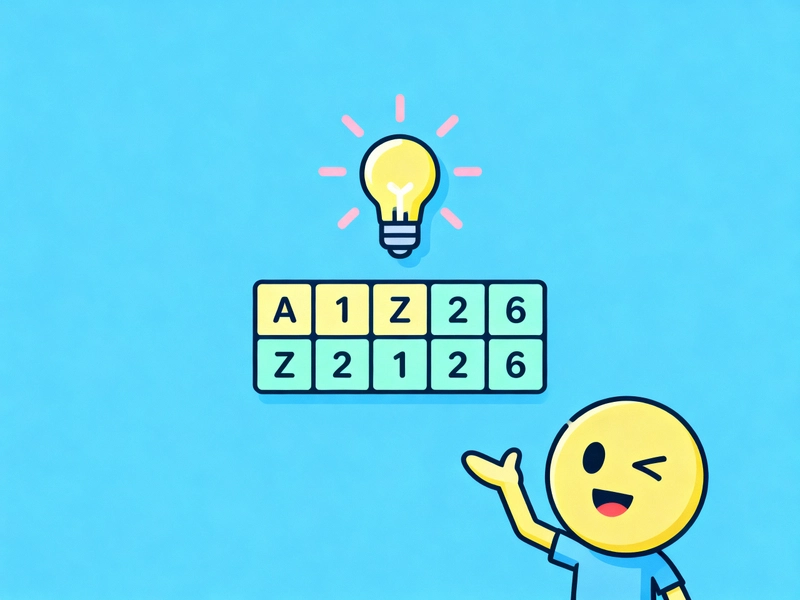
Forward conversion sends both uppercase and lowercase letters to the same symbol, so letter case is lost. Reverse mode emits uppercase. In reverse mode, literal # and ! are interpreted as H and I, even when those marks began as punctuation. The original is therefore not always reversible.
Glyph display depends on the destination
These are Unicode characters rather than a bundled font. Font support varies by platform and device; a missing glyph may appear as a box, and line height or width can change. Test the exact destination and keep essential labels in normal characters.
Decorative glyphs can obstruct reading
Search, copying, pronunciation tools, and a screen reader may treat the symbols differently from the letters they resemble. For accessibility, keep instructions, names, and required information in ordinary text and use this map only as a nonessential visual accent.
Observable behavior of the current mapper
The implementation is a small character transform with specific, testable boundaries.
One configured A-Z table
The forward branch looks up each letter in the same 26-entry map. It does not choose among styles or infer a language.
Local early-return path
A non-null local result is written to the output before loading state or the shared provider fetch begins. This statement describes this button action only, not every page or destination.
Partial reverse mapping
Known mapped glyphs return A-Z. Unmapped characters pass through, capitalization cannot be recovered, and glyphs that also serve as punctuation can be misread.
Client-side length and editing controls
The page blocks input beyond 500 characters. Direction, Copy, and Reset are the available controls; there is no custom alphabet selector.
Questions about the fixed symbol map
Mapping scope, reverse behavior, and display checks
Explore More Translator Tools
Check out these related translation and AI tools to enhance your experience
Convert, inspect, and test the destination
Keep the source if you may need its original capitalization or punctuation. The reverse map is a convenience for known output, not a lossless decoder.
Step 1: Enter no more than 500 characters
Type or paste a short sample. A-Z and a-z are eligible for substitution; other scripts and characters without map entries are returned as they were entered.
Step 2: Apply the fixed map locally
The browser-local conversion returns a result before the component reaches its provider branch. It does not use a language model. Neither sign-in nor a translation credit is used by this specific conversion action.
Step 3: Use the controls with the source preserved
Copy transfers the displayed result to the clipboard, and Reset clears both fields. When output already exists, the direction arrow swaps the input and output text panels before a reverse attempt.
Try the current A-Z substitution table
Use a short nonessential sample, compare it with the reference chart, and keep the source when capitalization or literal punctuation matters.